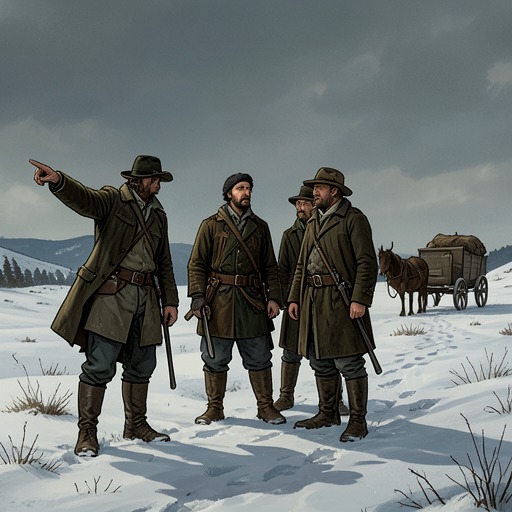
The winter spent trapped in the valley
Butcher's CrossingThe winter spent trapped in the valley is the expedition’s long ordeal of enforced stillness: a season in which the hunters’ freedom of movement narrows to the shelter and snowbound landscape, while their sense of time and their attachment to the place are transformed. The snow closes the pass behind Miller, William Andrews, Fred Schneider, and Charley Hoge. What first appeared to Andrews as an immense, nearly untouched wilderness becomes a confinement with no reliable end, and the valley’s quiet grandeur is joined by cold, hunger, and the continuing destruction of its bison.
Arrival and the Closing Pass
Before the snowfall, the party approaches the mountains after crossing the plains. Miller leads the wagon down through wooded hills to a river and then toward the valley. At the river, Andrews studies the pine forest across the water until its individual trees dissolve in his perception into a vast, motionless mass, like a frozen sea. The vision anticipates the valley’s peculiar power over him: the landscape seems to exceed ordinary measures and boundaries, even as the expedition is moving through it for practical purposes.
The valley itself appears after a difficult passage among the pines. From the trail, Andrews sees a long, narrow, level expanse of rich grass enclosed by mountains. Its stillness seems to belong to a place no human being has entered. The vision is immediately complicated by the dark, moving mass of the bison herd below. For Andrews, the valley is at once an overwhelming landscape and the destination of Miller’s hunt; its apparent untouched calm will not protect it from the expedition’s work.
The first snow falls after the men have been listening to the stillness around them. Andrews initially laughs at the flakes, but Miller and Fred Schneider are fixed on the darkening sky, and Charley Hoge sits rigidly on the wagon seat, eyes moving while his body remains still. The snowfall quickly ceases to be a passing curiosity. When Andrews emerges from his sack on the third morning, he finds the valley remade beneath a cloudless sky: snow lies in rolling drifts across the basin, buries the scattered pines along the mountain slope, and leaves only their tips showing in places. The familiar terrain has become strange beneath an immense, dazzling whiteness.
The Sentence of a Long Winter
Miller explains the practical consequence of the storm: the party cannot leave until the pass through which they entered is clear. He estimates that three or four weeks of good weather would be enough to open it, but says that such weather will not come before the end of winter. The men must remain until spring. His minimum estimate is six months, with eight as the maximum. Andrews repeats the figure of six months as if saying it aloud might make its duration imaginable; Miller turns from the prospect to the immediate need to get to work.
The forecast makes the pass, rather than any choice by the hunters, the measure of their freedom. Andrews later returns to the route taken by Miller and Schneider on their inspections and looks through a crooked track in the snow toward the narrow opening between two rocks. He cannot see the country beyond it. The obstructed view gives physical form to his uncertainty about departure: the way out exists, but the snow blocks both passage and sight.
The conditions do not settle into a single unchanging storm. Week after week, and then month after month, the weather shifts between bright, almost summerlike stillness and cold gray winds funneled down the valley. Snow falls softly through quiet air or is driven into drifts against the shelter until the men seem to be living in a cave dug out of the snow. At night the cold is severe even when the men press close together or wrap themselves in bison blankets; they suffer and sleep badly. The shelter offers refuge without making the winter comfortable or predictable.
The white landscape also imposes a bodily limit. After wandering away from camp without his protective glasses, Andrews is blinded by sunlight reflecting off the hard-packed snow. Kneeling, he presses snow against his closed eyelids, then tries to make his way back toward the dark shape of camp by glimpsing it through his fingers. Fred Schneider guides him to the shelter, where Andrews remains in darkness for nearly three days while his eyes recover. He never again looks at the snow without protection and does not return to the immense white valley. The episode makes the winter’s brightness as dangerous as its cold: even a familiar landscape can overwhelm the body when its conditions change.
Time, Labor, and the Diminishing Herd
Inside the confinement, the passage of time becomes difficult for Andrews to apprehend. He checks the notches Fred Schneider has cut into a pine branch to count the days, but continues doing so mechanically after the number has lost meaning. Schneider’s periodic demands for his pay provide another recurring marker. Andrews counts out the money from his pouch and hands it over, yet the transaction feels like a duty rather than evidence that time is moving. Days and weeks blur into the same arrested present.
This suspended time is set against the relentless, measurable reduction of the bison herd. Before the winter, Miller had described how quickly the animals had disappeared from Kansas: where the plains had once been black with bison, hunters were now fortunate to bring back a few hundred in a season. In the valley, that history becomes immediate. The men kill and process animals at a pace that strains Schneider and Andrews, who struggle to skin the carcasses before night and rise before dawn to cut into stiff bodies. Miller’s rifle continues through the day, its repeated reports wearing on them as they work.
Andrews realizes that he has never seriously imagined the herd’s final extinction, yet he has always understood that Miller will not leave while a single bison remains alive. He measures the expedition’s likely return by the number of animals left, rather than by the days passing, as Schneider does. The valley thus contains two opposed forms of duration: winter seems not to advance at all, while the herd is being reduced toward an end. Andrews’s sense of the outside world also recedes. Butcher’s Crossing, the plains, and the mountain they crossed become dim and dreamlike; he has trouble imagining how it will feel to leave. Looking across the valley, he feels that its contours give his own existence a shape and place, and cannot picture himself elsewhere.
Thaw and Release
The end does not arrive with a sudden change of season. The hunters wait even as snow begins to melt in small streams beyond the camp, and Andrews finds the prospect of departure difficult to bear. His impatience is not like Fred Schneider’s plainly physical longing for good food, a clean bed, and a woman. Andrews recognizes that his own desire contains something of those wants but remains more intense and less definable: he cannot say what he hopes to recover or what he wants to escape. The pass is an exit from confinement, but the prospect of leaving the valley unsettles him rather than simply relieving him.
They continue waiting until the end of April. One night beside the fire, Miller suddenly tells the men to sleep well because they will load the wagon and leave the next day. Fred Schneider springs up, cries out, and repeatedly slaps Miller on the shoulder, laughing with relief. Andrews’s response has been less visible, but the announcement resolves the condition that has governed the winter: the pass is open enough to travel, and the expedition can finally depart.
The winter leaves the valley with a divided meaning. It is a place of danger and involuntary confinement, where snow can blind a man, bury the shelter, and erase ordinary measures of time. Yet its scale and stillness have also become central to Andrews’s sense of himself. The party’s release ends the physical entrapment, but it does not undo the attachment formed there—or the devastation of a herd that Miller’s hunt has continued to thin.